
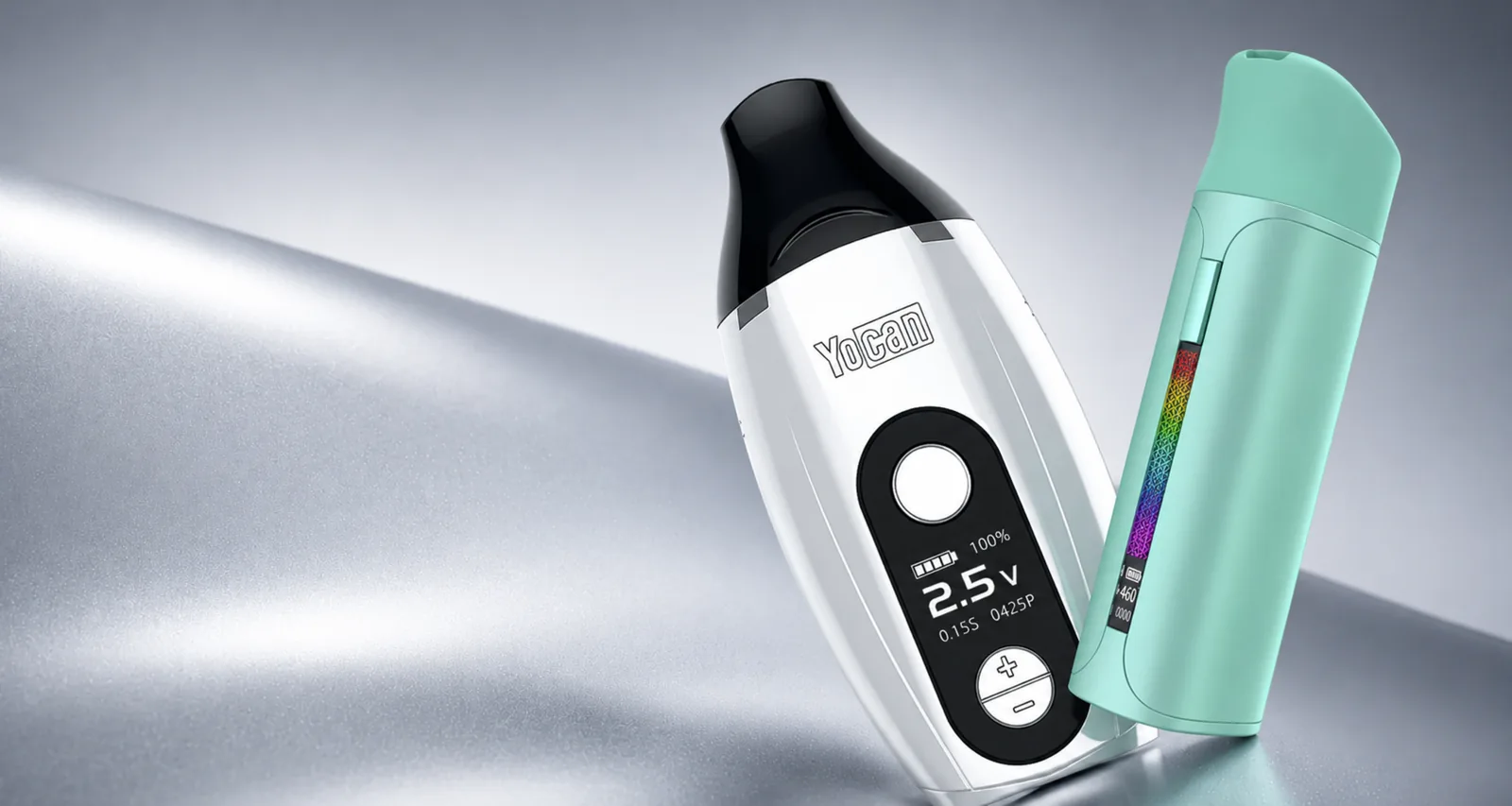
“Pen” describes the shape, not the material or heating system. A dab pen is a refillable concentrate device with its own coil or cup. A cart pen is a battery attached to a self-contained 510 cartridge. They can look similar while requiring completely different loading, cleaning, and replacement habits.
Core difference
A dab pen's heating chamber belongs to the reusable device. You open it, place a small amount of compatible concentrate into the intended area, activate the coil, then clean and eventually replace that coil.
A cart pen's heating chamber and material are inside the cartridge. The reusable piece is mainly the battery. When the cartridge is empty or fails, it is replaced according to local rules.
Neither category includes material with the hardware purchase. Adults must obtain legal products separately and follow provincial requirements.
Side-by-side comparison
| Factor | Dab pen | Cart pen / 510 battery |
|---|---|---|
| Material container | Refillable device chamber | Separate cartridge |
| Setup | Open and load chamber | Attach cartridge |
| Cleaning | Chamber, mouthpiece, contacts | Mainly battery and exterior contacts |
| Consumable hardware | Replacement coil or cup | Complete cartridge |
| Controls | One-button to multi-level | Draw, presets, or precise voltage |
| Portability | Compact, but loaded chamber needs care | Usually smallest and simplest |
Dab-pen advantages
Dab pens let the owner choose compatible concentrate separately and reuse the same chamber platform. Different coil styles can change the heating approach within supported model families. Established products such as Evolve Plus have widely available replacement packs; the under-$50 dab pen guide compares the current options.
They also keep the complete setup in one device. There is no cartridge width to match or magnetic adapter to lose.
Dab-pen tradeoffs
Loading requires access to the chamber and a clean tool. Residue accumulates on the mouthpiece, walls, coil, and thread. Coils are consumable, and an overloaded chamber can leak into the connection.
An exposed quartz-rod coil should not be scraped, while ceramic and quartz cups have their own care requirements. A dab pen is economical only when the owner is willing to clean it and buy the exact compatible replacement.
Cart-pen advantages
A cartridge is fast to connect and keeps its material contained. Small batteries such as Kodo Pro provide exact voltage in a body that is smaller than many dab pens. Concealed batteries such as UNI Pro and Ziva protect more of the cartridge — the Canadian 510 battery guide compares the formats.
Battery maintenance is simple: keep contacts clean, charge correctly, and store without leakage. Switching cartridges does not require cleaning a concentrate chamber.
Cart-pen tradeoffs
Cartridge dimensions, resistance, airflow, and recommended voltage vary. A concealed battery may not fit every width. A cracked or clogged cartridge is usually replaced as a complete unit rather than repaired.
The exposed glass or plastic tank can break under side pressure. Higher voltage can overheat a cartridge, and leakage can damage a battery connection.
Upfront and recurring cost
A basic 510 battery often costs less than a complete dab pen. Its recurring hardware cost is low, but every cartridge includes its own heating hardware and container. A dab pen costs more than a bare battery and requires coil packs, yet the chamber is refilled rather than replaced as a complete cartridge each time.
Material cost varies too widely by province and product to make one category universally cheaper. Compare legal local prices, coil pack cost, and how often you realistically replace hardware.
Controls and temperature
Dab pens may use fixed output, three voltage levels, or automatic heat cycles. Cartridge batteries range from buttonless fixed voltage to precise 0.1-volt adjustment. In both categories, maximum voltage is not a quality score.
Start with the device and material producer's guidance — the 510 cartridge voltage chart provides conservative starting bands. Lower settings are the cautious starting point. Preheat is useful for specific conditions but should not be repeated continuously.
Cleaning
Dab pens need the more involved routine. Let the device cool, disassemble only removable parts, wipe residue, protect electronics from liquid, and replace damaged coils. Cart batteries mainly need dry, clean threads and chambers.
A leaking cartridge changes that equation. Remove it immediately and clean the battery exterior according to its manual. Do not allow liquid to remain inside a concealed body.
Which should you choose?
Choose a dab pen when you want a refillable dedicated concentrate chamber and accept cleaning and coil replacement. Choose a cart pen when you value the simplest setup, smallest battery options, and cartridge-based convenience.
Some owners use both because the formats serve different situations. If buying only one, base the decision on the legal material format you actually purchase—not on the shape of the device.
Common questions
Is a dab pen the same as a cart battery?
No. A dab pen has a chamber or coil that you load with compatible concentrate. A cart battery powers a separate prefilled or refillable 510 cartridge.
Can I screw a 510 cartridge onto a dab pen?
Only if the specific device explicitly supports cartridge use. Similar threads do not guarantee compatible voltage, airflow, or safe operation.
Which costs less over time?
A cart battery has little hardware maintenance, while the cartridge is replaced separately. A dab pen reuses the device but needs cleaning and replacement coils. Total cost depends on local material prices and usage.
Which is easier to carry?
A small cart battery is usually the simplest. A dab pen carries its own loaded chamber and needs more attention to upright storage and cleanliness.