
The correct voltage is a range, not a magic number. A 510 battery supplies electrical power, while the cartridge's resistance and construction determine how that power becomes heat. Two cartridges can behave differently at the same displayed voltage. Manufacturer guidance printed on the package or supplied by the licensed producer takes priority over any general chart.
Conservative starting chart
| Battery voltage | Practical use | What to watch |
|---|---|---|
| 1.8–2.2V | Gentle preheat or low-temperature starting range | Output may be light; confirm the cartridge can activate this low |
| 2.2–2.6V | Lower everyday range for many modern cartridges | Usually a useful first test range |
| 2.6–3.2V | Balanced middle range when lower settings are insufficient | Cartridge temperature and flavour changes |
| 3.2–3.6V | Higher heat for cartridges that explicitly support it | Faster material use, harsher or burnt output |
| Above 3.6V | Specialized or manufacturer-directed use | High risk of overheating many standard carts |
Cartridge hardware manufacturers publish similar ranges: CCELL recommends roughly 2.5–3.5 volts for its ceramic cartridges depending on the oil, with live-resin-style cartridges toward the low end of that band because higher heat degrades terpenes and produces harsh output. Treat these as starting references, not a rule for every cartridge sold in Canada.
Why lower voltage is the safer starting point
Starting low makes it easier to observe the cartridge without overheating it. If output is weak, increase in 0.1-volt steps or move to the next preset. Let the cartridge cool between tests.
Starting high can scorch material near the heating inlet before you know the cartridge's behaviour. Once the wick or heating surface is burnt, reducing voltage cannot reverse the damage.
Cartridge type and viscosity
Thicker material may need gentle warming to move toward the intake holes, especially in a cold Canadian environment. That does not mean the normal activation voltage should be set to maximum. A controlled low-voltage preheat cycle and upright storage are better first tools.
More fluid cartridges can flood or leak when overheated. If bubbles race through the chamber, liquid appears at the thread, or the cartridge body becomes hot, stop and let it cool.
Labels such as distillate, live resin, rosin, or CBD describe contents broadly but do not reveal the exact coil resistance or producer's hardware. Use the package recommendation when available.
Resistance changes the power delivered
Electrical power depends on voltage and resistance. A lower-resistance cartridge draws more power at the same voltage than a higher-resistance cartridge. That is why copying a setting from another cartridge can produce a different result.
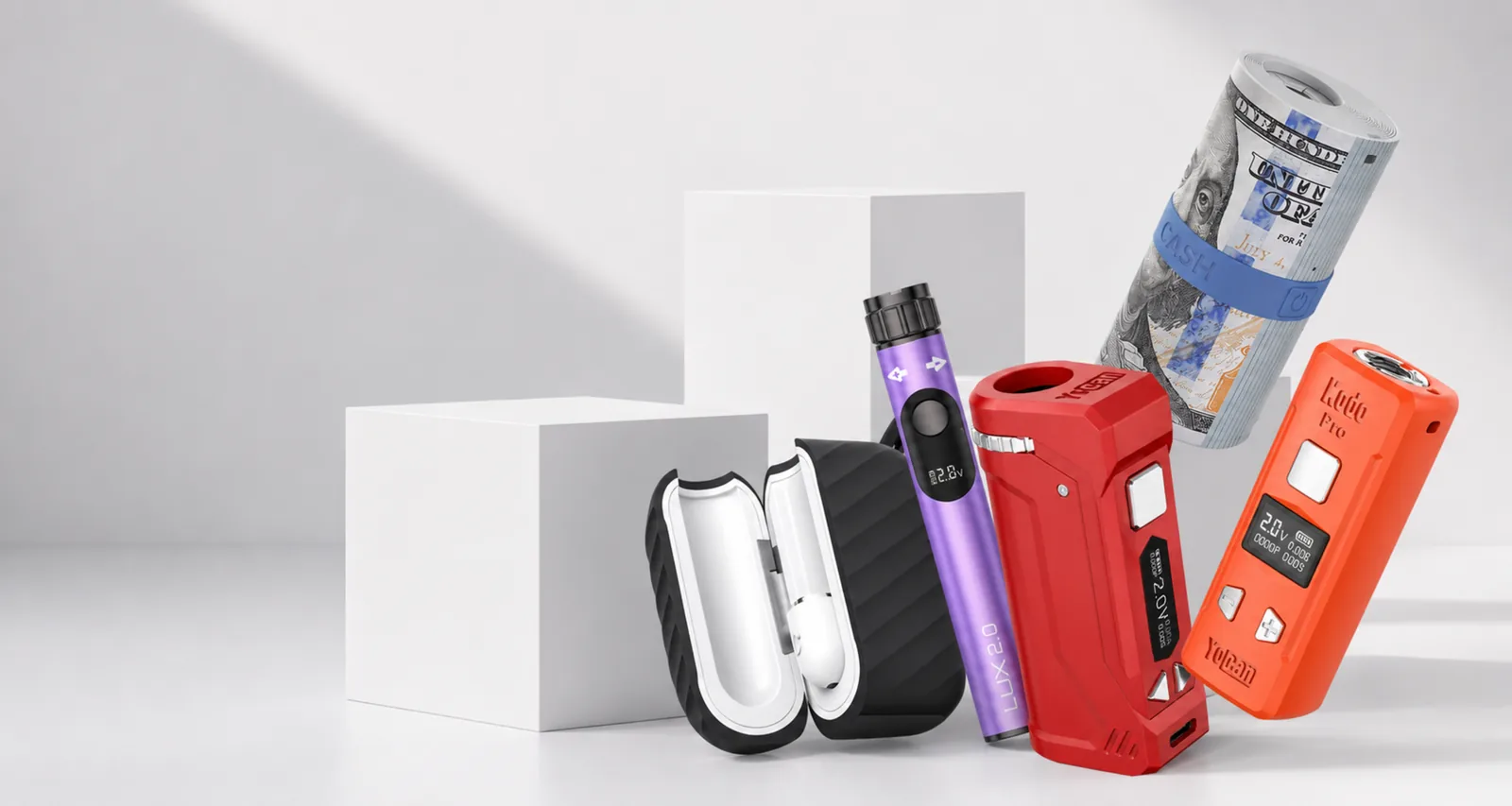
Screen batteries such as the UNI Pro and Kodo Pro may display resistance or detect a short. If a reading jumps, disappears, or falls outside the battery's supported range, clean the contacts and test the connection. Do not use voltage to override a no-atomizer or short warning.
Preset batteries
Three-level batteries often use colours instead of numbers. Check the manual for the voltage assigned to each colour; colours are not standardized across brands or even every model. Begin with the lowest level.
If the battery offers only one fixed setting, match it with cartridges designed for standard fixed-voltage use. An adjustable battery is the more flexible option when you regularly change cartridge types.
Using preheat correctly
Preheat should be a brief low-power cycle. Keep the cartridge upright, run one cycle, and test normal airflow. Stop if the cartridge becomes hot. Multiple back-to-back cycles can thin material too far and push it into the airway or battery connection.
Preheat does not repair a broken coil, cracked tank, blocked centre airway, or poor electrical connection. Those problems require cartridge replacement or physical cleaning allowed by the producer. Model-specific preheat steps are in the Kodo Pro and UNI Pro manuals.
If output is weak
Confirm that the battery is charged and the cartridge contacts are clean. Check airflow openings and make sure the cartridge is not overtightened. Increase voltage one small step only after those checks.
A nearly empty cartridge, damaged heating element, or blocked intake may remain weak at every setting. More voltage can turn a hardware problem into a burnt cartridge.
If output tastes burnt or harsh
Stop activation and let the cartridge cool. Reduce voltage, shorten button holds, and wait between draws. Verify that material still covers the intake openings when the producer requires it.
If burnt output persists at low voltage, the cartridge may already be damaged. Continuing to use it is unlikely to improve performance.
If the cartridge clogs or leaks
Store it upright at moderate temperature. Clean only the exterior and mouthpiece according to producer instructions. Keep leaked material off the battery thread and inside of concealed chambers.
Do not insert metal deeply into the airway or heat the cartridge with an open flame, hair dryer, vehicle vent, or other uncontrolled source. If the tank is cracked or repeatedly leaks, replace it.
A repeatable tuning method
Write down the cartridge name and starting voltage. Take one short test at the low setting, wait, and increase by one step only if needed. When you find a suitable point, leave it there rather than adjusting constantly.
The best battery for this method has exact low-voltage adjustment and a clear display. The best setting is the lowest one that operates the specific cartridge satisfactorily without excess heat.
Common questions
What voltage should I start with for a 510 cart?
Start at the low end of the cartridge manufacturer's recommended range. When no guidance is available, approximately 2.0–2.4 volts is a conservative starting band for an adjustable battery.
Is 4.2 volts too high for a cartridge?
It can be too hot for many cartridges. A battery's maximum setting is not a recommended everyday setting. Use the cartridge maker's limit and increase only when needed.
Should I raise voltage when a cart is clogged?
Not immediately. Keep the cart upright, clear the mouthpiece as instructed, and use one controlled low-voltage preheat cycle if supported. Excess heat can worsen leakage or burnt output.
Why does the same voltage feel different on two cartridges?
Heating element resistance, oil viscosity, airflow, intake design, and battery calibration differ. Treat the chart as a starting framework rather than a guarantee.