
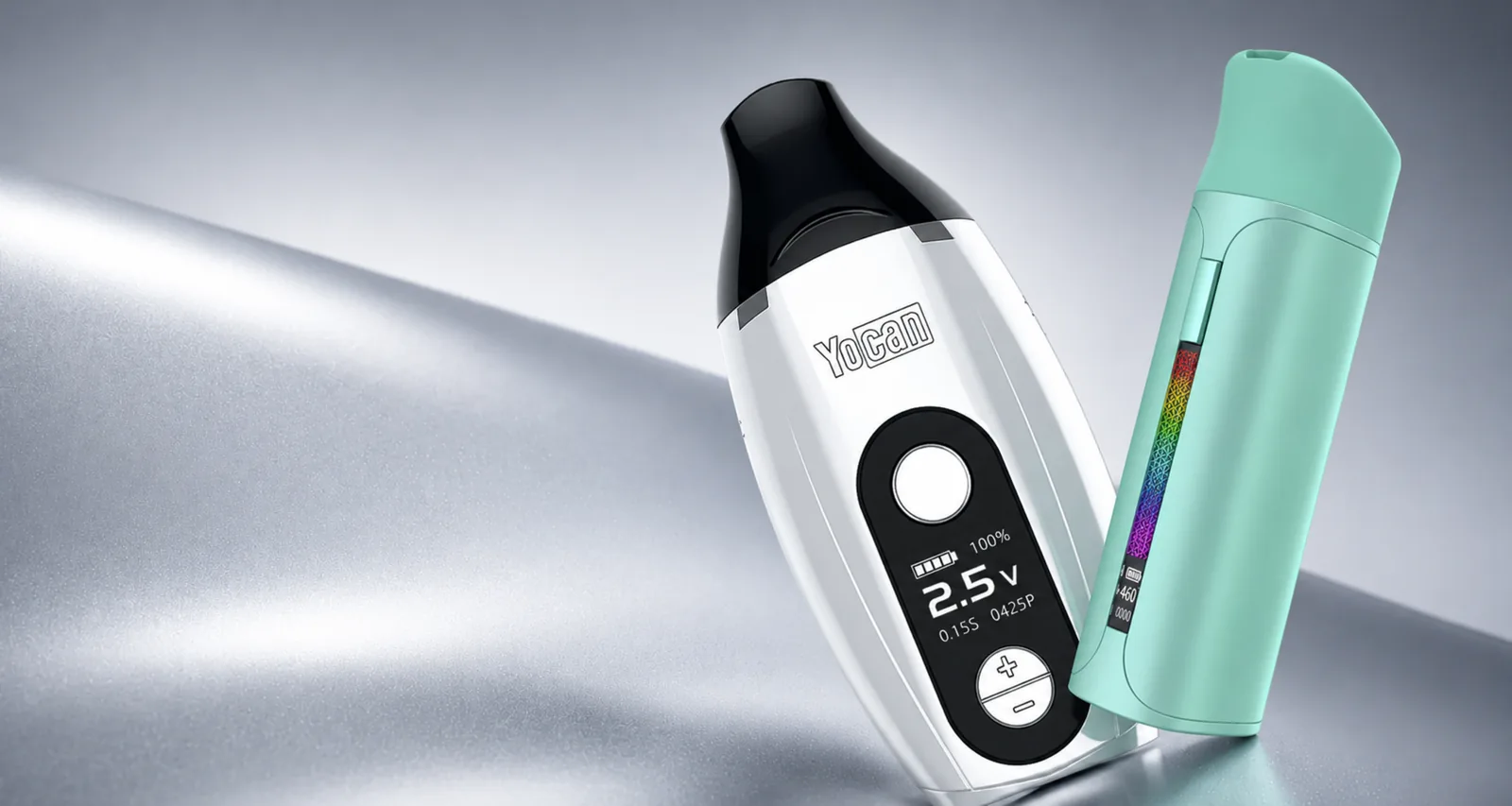
Terp pearls are small quartz balls that move inside a compatible heated cup. In the Yocan Orbit, they are not a decorative add-on: the coil-less quartz cup, top airflow, glass mouthpiece, and two supplied quartz balls are designed as one system. Airflow causes the balls to circulate and redistribute material across the hot surface.
Orbit chamber design
Unlike an Evolve-style coil with exposed quartz rods and wire, the Orbit heats a quartz cup. The material sits against the cup rather than directly on exposed wrapped elements. Two quartz balls rest inside the cup.
Yocan lists a 0.4-ohm quartz-balls coil, 1700 mAh battery, USB-C charging, and three voltage levels. The cup remains a model-specific replaceable assembly even though it is described as coil-less at the loading surface.
How the pearls move
Air enters through the Orbit's top airflow system and passes through the chamber during a draw. Proper airflow causes the balls to roll around the cup. Their movement spreads material and changes which part of the liquid contacts the heated quartz.
Pearls that do not move may indicate thick residue, an overloaded cup, obstructed airflow, incorrect assembly, or a draw that does not engage the intended path. More voltage is not always the solution.
Official voltage levels
The Orbit uses three listed settings:
- White: 3.4 volts
- Blue: 3.7 volts
- Green: 4.0 volts
Start on white with a clean cup and modest load. Move to blue only when the lower setting is insufficient. Green supplies the most heat and should not become the default simply because it is available.
Allow the cup to cool between activations. Repeated long cycles can bake residue onto quartz and make later cleaning harder.
Loading the cup
Turn the device off and confirm the cup is cool. Remove the mouthpiece according to the manual. Place a small amount in the cup without covering airflow openings or filling above the intended chamber area.
Keep tools away from the cup wall and pearls once the device is hot. A heated loading tool can help transfer material cleanly, but it should not be used to scrape quartz or force a jammed pearl.
Reinstall the mouthpiece securely. The glass should sit correctly so airflow follows the designed route.
Getting the pearls to spin
Use a steady controlled draw rather than an extremely hard pull. If the balls remain still, stop and inspect after cooling. Confirm that both are present, clean, and free to move. Check for residue around the cup edge and inside the mouthpiece.
Overloading is a common cause of poor movement. When the cup is too full, the pearls push through thick material rather than rolling freely. Smaller loads are easier to heat and clean.
Do not add random pearls. Diameter, mass, and clearance affect movement. Too many balls can jam or reduce airflow; a ball that is too large can damage the cup or mouthpiece.
Cleaning the quartz cup and pearls
Let the Orbit cool completely and disconnect it from charging. Remove the mouthpiece and pearls over a clear surface so the small balls are not lost. Wipe loose residue before using any permitted cleaning liquid.
Follow the manufacturer instructions for the removable quartz components — the coil cleaning guide covers the general liquid-and-drying rules. If alcohol is permitted, keep it away from the battery and use it only on separated parts. Let the cup, pearls, and glass dry fully before reassembly.
Do not scrape quartz with metal or expose hot glass to sudden cold liquid. Thermal shock can crack parts.
When to replace the cup
Replace the assembly when quartz is cracked or chipped, the device repeatedly reports an electrical fault after cleaning and reseating, or heating becomes inconsistent. A cup that is visually clean can still have an exhausted internal connection.
Confirm that the replacement is explicitly listed for Orbit in the coil compatibility chart. A quartz cup from another model may look similar without matching resistance, contacts, or airflow.
Orbit versus exposed quartz coils
Exposed coils heat directly and respond quickly but have rods and wire in the loading area. Orbit's cup creates a smooth loading surface and uses pearl movement for redistribution. The cup still needs regular cleaning and is not immune to damage.
Choose Orbit when the cup-and-pearl workflow appeals to you and you accept glass handling and small-part cleaning. Choose a conventional quartz-rod pen when the simplest chamber and widely stocked multi-pack coils matter more — the under-$50 dab pen roundup compares those options.
Practical ownership tips
Store the device upright, keep the mouthpiece protected, and clean before residue immobilizes the pearls. Carry spare balls in a sealed labelled container if replacements are available, because they are easy to lose during cleaning.
The Orbit works best as designed: two correct quartz balls, a modest centred load, unobstructed top airflow, conservative voltage, and a clean cup. Changing several of those variables at once makes troubleshooting harder rather than improving performance.
Official specifications
Common questions
What do the quartz balls do in a Yocan Orbit?
Airflow moves the balls around the heated quartz cup, helping redistribute material across the cup surface. They are part of the Orbit's model-specific chamber design.
Can I add more terp pearls to the Orbit?
Use the quantity and size specified for the Orbit. Extra or oversized pearls can restrict airflow, jam the cup, or contact parts not designed for them.
What are the Orbit voltage settings?
Yocan lists three levels: 3.4 volts indicated by white, 3.7 volts by blue, and 4.0 volts by green. Start at the lowest setting.
How do I clean Orbit terp pearls?
Let every part cool, remove the pearls carefully, and follow the manual for quartz cleaning. Keep liquid away from the battery and dry all parts fully before reassembly.