
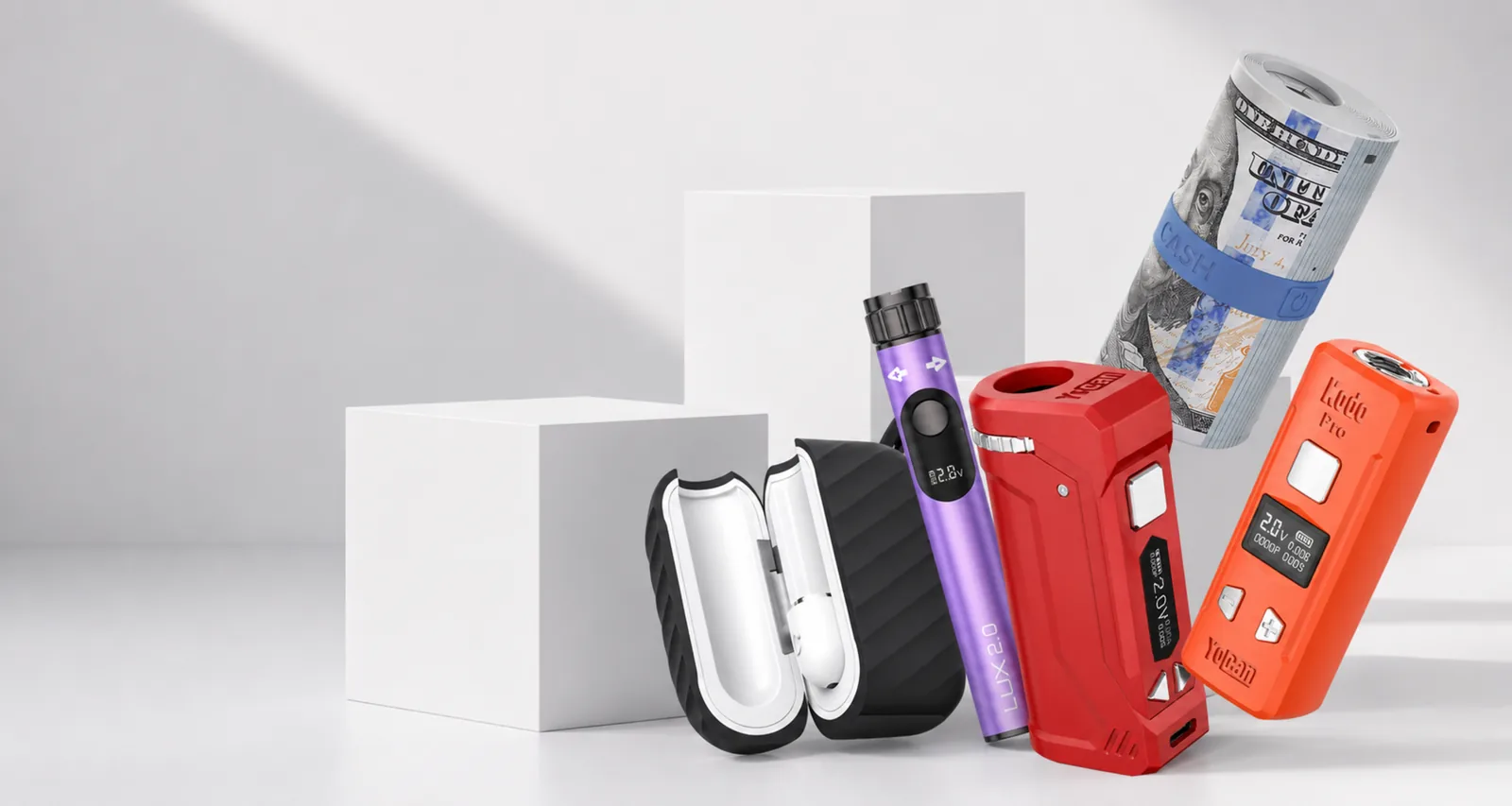
Choose the Kodo Plus for five simple voltage presets and the largest battery, at 900 mAh. Choose the Kodo Pro or Kodo Star for precise 1.8–4.2 V control in 0.1 V steps on a 400 mAh battery. The Kodo Pro adds an OLED puff counter; the Kodo Star uses Yocan's Galaxy Full Display. All three screw directly onto 510 cartridges.
Comparison at a glance
The real split is presets versus precise voltage. Battery size, display and body follow from that choice.
| Feature | Kodo Star | Kodo Pro | Kodo Plus |
|---|---|---|---|
| Voltage control | 1.8–4.2 V in 0.1 V steps | 1.8–4.2 V in 0.1 V steps | Five presets: 2.4, 2.8, 3.2, 3.6, 4.0 V |
| Buttons | Power button plus + and − | Power button plus + and − | Power button plus a voltage button |
| Display | Galaxy Full Display: voltage, battery, draw timer | OLED: voltage, battery, puff count, timer | Indicator lights for the selected preset |
| Preheat | 1.8 V for 10 seconds | 1.8 V for 10 seconds | 10 seconds |
| Battery | 400 mAh | 400 mAh | 900 mAh |
| Charging | USB-C, 5 V/1 A, about 0.8 hours | USB-C | USB-C, 5 V/1 A |
| Listed size | 57 × 23 × 18.5 mm | Not listed by Yocan | 18 × 25 × 65 mm |
| Body | Plastic | Not listed by Yocan | Aluminum alloy |
| Connection | Direct 510 thread, cartridge exposed | Direct 510 thread, cartridge exposed | Direct 510 thread, cartridge exposed |
| Safety cutoff | 15 seconds | Built in | 15 seconds |
Figures come from Yocan's official product pages and manuals. Revisions can change details, so the leaflet in your box remains the final authority.
Kodo Star: precise voltage with the Galaxy Full Display
The Kodo Star is the pick if you want exact voltage with Yocan's Galaxy Full Display in a light, compact body. Yocan lists 1.8–4.2 V in 0.1 V steps, a 1.8 V ten-second preheat and a 400 mAh battery.
Its Galaxy Full Display shows voltage, battery level and a timer that counts the seconds of each draw. The body is plastic, and Yocan lists it at 57 × 23 × 18.5 mm. USB-C charging at 5 V/1 A takes about 0.8 hours, according to Yocan's specification table.
Voltage is set with plus and minus buttons, separate from the power button. Yocan lists a 15-second safety cutoff and automatic shut-off after one hour.
Kodo Pro: precise voltage with a puff counter
The Kodo Pro is the pick if you want exact voltage with a puff counter and timer on screen. It shares the Kodo Star's 1.8–4.2 V range, 0.1 V steps, 1.8 V ten-second preheat and 400 mAh battery.
Its OLED screen shows voltage, battery, puff count and a timer. Yocan's help centre says five presses of the power button within three seconds turn it on or off, and holding the minus and power buttons together resets it. It charges by USB-C.
The Kodo Pro manual covers setup, starting voltages and "No Atomizer" or "Shorted" messages.
Kodo Plus: presets and the largest battery
The Kodo Plus is the pick if you would rather tap through five fixed settings than set an exact number. It also has the largest battery of the three: 900 mAh, more than double the others.
Yocan lists five presets: 2.4, 2.8, 3.2, 3.6 and 4.0 V. A dedicated voltage button cycles through them, and indicator lights show the selected level instead of a numeric screen. The power button fires the battery and starts a ten-second preheat.
The body is aluminum alloy, listed at 18 × 25 × 65 mm, with USB-C charging at 5 V/1 A. Yocan's US store lists a 15-second maximum activation and automatic shut-off after one hour of inactivity.
Yocan also sells a Kodo Plus Zodiac Edition. Yocan's own pages do not show identical voltage specifications for the two editions, so check the leaflet for the version you buy.
Controls: precise voltage vs presets
Precise voltage lets you match a cartridge maker's recommended setting; presets trade that flexibility for fewer decisions. The Kodo Star and Kodo Pro both move in 0.1 V steps across 1.8–4.2 V. The Kodo Plus jumps in 0.4 V steps between 2.4 and 4.0 V.
If your cartridge works best between two presets, only the Star or Pro can hit that number. If you mostly use one or two settings, the Kodo Plus moves between them with one tap per step.
All three turn on with five quick presses of the power button. Yocan's pages describe a double press for the ten-second preheat on each model, but confirm the sequence in your leaflet. Start low and raise voltage gradually; the 510 cartridge voltage chart gives conservative starting bands.
Display
The Kodo Pro shows the most information, the Kodo Star has Yocan's Galaxy Full Display, and the Kodo Plus has no screen. The Pro's OLED adds a puff counter and timer. The Star's display shows voltage, battery level in 10% steps and a draw timer.
The Plus uses indicator lights to show the selected preset. That is less detailed, but there is nothing to navigate.
Battery and charging
The Kodo Plus has the most capacity: 900 mAh against 400 mAh on the Kodo Star and Kodo Pro. Higher capacity usually means more use between charges, though voltage, activation time and battery age also matter.
All three charge by USB-C. Yocan lists about 0.8 hours for the Kodo Star at 5 V/1 A. Use a basic 5 V adapter rather than an unknown fast charger, and do not leave a battery charging unattended. If one stops charging, work through the not-charging checklist.
Size and cartridge fit
All three screw directly onto a standard 510 cartridge, so no chamber limits cartridge width. Yocan lists the Kodo Star at 57 × 23 × 18.5 mm and the Kodo Plus at 18 × 25 × 65 mm; it does not publish dimensions for the Kodo Pro.
Because the cartridge sits exposed, side pressure in a pocket can stress the cartridge or thread. Thread it on until gently snug and stop. Yocan lists all three for cartridges of about 0.8 Ω and up, and notes that a wax atomizer on the Kodo Pro may trigger a short warning. Use them with 510 oil cartridges.
If you need the cartridge enclosed, a UNI battery is the better format. See the UNI 3.0 vs UNI Pro comparison.
Safety
Turn the battery off before it goes into a pocket or bag, and remove the cartridge for longer storage. Stop using any battery that becomes hot, swollen or damaged, or smells unusual. Do not open the battery or use metal tools on the 510 contact. Seek warranty support instead.
Warning flashes and screen messages are explained in the blink-code guide.
Which should you choose?
Choose the Kodo Plus for presets and the longest time between charges. Choose the Kodo Pro for exact voltage with a puff counter. Choose the Kodo Star for exact voltage with Yocan's Galaxy Full Display in a compact plastic body.
- Simplest controls and biggest battery: Kodo Plus.
- Exact voltage plus puff and timer readout: Kodo Pro.
- Exact voltage with the Galaxy Full Display: Kodo Star.
- Cartridge that needs a setting between presets: Kodo Star or Kodo Pro.
- Cartridge fully enclosed: none of the three. Look at the UNI series instead.
For a wider view of formats, the Canadian 510 battery guide compares Kodo, UNI and pen batteries.
Official references
Common questions
What is the difference between the Kodo Star and the Kodo Pro?
Both have a 400 mAh battery, USB-C charging and 1.8–4.2 V control in 0.1 V steps. The Kodo Pro uses an OLED screen with a puff counter; the Kodo Star uses Yocan's Galaxy Full Display in a plastic body.
Is the Kodo Plus better than the Kodo Pro?
It depends on the controls you want. The Kodo Plus has a 900 mAh battery and five fixed voltage presets. The Kodo Pro has a smaller 400 mAh battery but lets you set any voltage from 1.8 to 4.2 V in 0.1 V steps.
What voltages does the Kodo Plus use?
Yocan lists five presets for the Kodo Plus: 2.4, 2.8, 3.2, 3.6 and 4.0 V. A separate voltage button cycles through them.
Will a wide cartridge fit a Kodo battery?
All three Kodo models screw directly onto a standard 510 cartridge with no chamber around it, so width is not limited by a chamber. Very wide or heavy cartridges still need gentle handling because they sit exposed.
Can I use a wax atomizer on a Kodo?
These batteries are designed for 510 oil cartridges. Yocan notes that a wax atomizer on the Kodo Pro may trigger a short warning, and all three are listed for cartridges of about 0.8 Ω and up.